| RICHMOND, VA — In response to the historic ongoing drought caused by below average rainfall throughout the Commonwealth for nearly one year, Governor Spanberger and Roanoke Region leaders today urged Virginians to increase commonsense water conservation efforts.
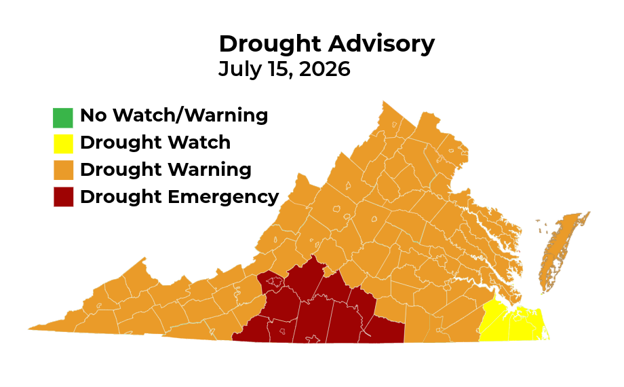
While most of the Commonwealth remains in either a drought warning or watch status, the Roanoke Drought Evaluation Region — which includes Bedford, Campbell, Charlotte, Franklin, Halifax, Henry, Mecklenburg, Patrick, Pittsylvania, and Roanoke counties, and the cities of Danville, Martinsville, Roanoke, and Salem — has reached emergency status. On July 7, Virginia’s Drought Monitoring Task Force (DMTF) recommended a drought emergency for the Roanoke Drought Evaluation Region. As a result, local and regional leaders are working together to determine next steps if the situation does not immediately improve.
“In the midst of this historic dry period, all Virginians can help preserve our water supply,” said Governor Abigail Spanberger. “Increased water conservation measures are critical to protect access to adequate water supplies for Virginia’s families, farms, and communities as the drought persists. I appreciate the work of Virginia’s Drought Monitoring Task Force to paint an accurate picture of the severe drought conditions. We will continue to evaluate the impacts and how we can contend with this historic drought.”
“We continue to work alongside our partners throughout the Commonwealth to implement critical steps to protect our water supply during this prolonged period of exceptionally dry conditions,” said Adrienne Kotula, the Commonwealth’s Acting Drought Coordinator and Deputy Secretary of Natural and Historic Resources. “Unfortunately, if conditions on the ground do not rapidly improve, mandatory water conservation measures may be necessary in the Roanoke Region.”
“Virginia’s farmers have been struggling with a drought that began to take root in 2025 and has become more severe throughout 2026,” said Scott Sink, President of Virginia Farm Bureau. “The drought has impacted planting, availability of hay and pasture, and water access for crops and livestock. We continue to coordinate with our partners at VDACS, DOF, and other state and federal agencies to secure assistance and communicate needs. Recent rains have helped in the short term, but we anticipate long-term drought conditions to continue to impact Virginia agriculture and urge Virginians to implement best management practices related to water use and to report drought impacts they are experiencing to their local Virginia Cooperative Extension and FSA offices.”
“Providing a safe and reliable water supply is a responsibility we take seriously, and we can accomplish this goal by proactively managing the challenges of these extended dry conditions through careful planning, operational adjustments, and responsible stewardship of our water resources,” said Michael T. McEvoy, Executive Director, Western Virginia Water Authority. “While these efforts are helping maintain reliable service, water conservation is an essential part of our shared response. We encourage residents to take simple, voluntary steps to use water wisely. By reducing water use today, we can preserve available resources and help our communities better withstand continued dry conditions.”
“Protecting our water supply is a priority shared by leaders across the region,” said Senator Chris Head. “I continue to hear from farmers, small business owners, and families who are worried about the drought facing our region — and know how vital a reliable water supply is to our economy and our way of life. As we work to meet this challenge, I will continue to support the Virginians most affected by these conditions and make sure our community always has a voice in these decisions.”
“Over the past several months, I have heard directly from Virginians across the 41st District who have shared their concerns about declining water levels and below-average rainfall,” said Delegate Lily Franklin. “The data is clear: our region is facing a drought emergency. It is important that we take action to protect our farmland, our communities, and our entire economy.”
CURRENT DROUGHT STATUS |


July 15, 2026 @ 2:24 pm
Bonuses, raises, perks, and bennies to everyone responsible for establishing data centers during this time. Geniuses, all of you.
July 16, 2026 @ 12:04 pm
But hey! Let’s bring in some more data centers.