
What was The Turtle?
 On the night of September 6, 1776, a new form of warfare began in New York Harbor. Sgt. Ezra Lee maneuvered a small, one-man, American-made submarine under the dark waters toward the British fleet. It was affectionately known as “The Turtle” because it looked like two Turtle shells joined together.
He planned to approach the British Warship the HMS Eagle under the water and get under the ship. Once he was beneath the ship, he was going to drill a hole in the hull and attach explosives. He would drive the ship away and escape before the explosives detonated.
The Americans were at war with the greatest, largest, and strongest navy in the world. They could not compete on top of the water, so why not try a new approach?
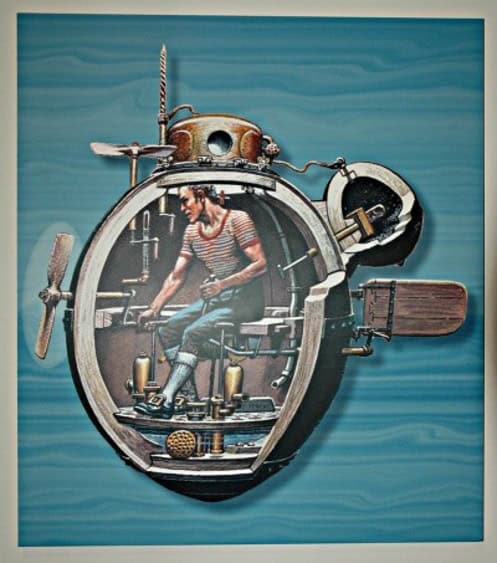 David Bushnell invented and built the Turtle in 1775. He was born in Connecticut and studied mathematics. During his studies, he proved that black powder could be detonated underwater. Its purpose was to attach explosives to British ships blockading New York Harbor and other American Ports. It had many innovative features such as a screw propeller for movement, water ballast for slipping under the surface, and a clockwork mechanism to detonate explosives under the water. He wanted to use his knowledge to attack the British.
The Turtle was made of oak with Iron bands and brass fittings. It was only big enough for one person inside. It was driven by a foot-pedal propeller and a hand-operated crank. It required a strong and physically fit person to operate it. There were porthole windows near the top for the operator to see out. There was a hatch on top to get in and out of the craft. The hatch was also the only way for air to get inside the Turtle.
It was intended to be used at night and travel near the surface with the hatch open until it got close to the intended target. Then it would go under the water to attach the explosive mine and leave the area. To see his compass and other gauges, bioluminescent foxfire was attached to the needles so they could be read in the dark.
He was unable to attach the mine to the hull of the ship, possibly because of copper sheathing protecting the ship, or because the wooden planks were just too hard. He was tired and worn out from the physical exertion of driving the submarine, and dawn was fast approaching, so he decided to abort the mission. He released the mine, hoping it would detonate near a ship when the timer went off. It exploded harmlessly in the water.
They would try two more times without success. Later, the Turtle was lost when they were transporting it on a sloop, and the ship was sunk by the British navy. It was belived that the Americans salvaged it, but it was never used again.
Bushnell continued to work for the American cause. He designed floating mines or torpedoes, and they were used during the war and actually sank a British ship.
Even though the Turtle never sank an enemy ship, it was a technological marvel for its day. It laid the groundwork for submarine warfare in the future. It remains a symbol of American ingenuity during the War of Independence against the greatest navy on earth at that time.
Thank you for reading “Our History Matters. I always enjoy hearing from readers; contact me at tj.cox2023@outlook.com with your questions, comments, ideas, or suggestions.