
Battle of Sullivan’s Island
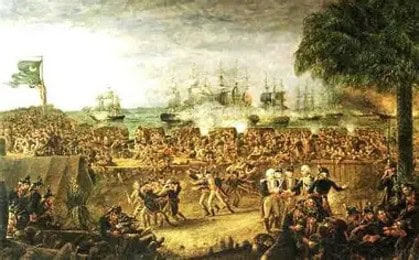 As June of 1776 unfolded, Americans were moving steadily toward independence. While delegates in Philadelphia debated whether to separate from Great Britain, British military leaders were preparing a major campaign to crush the rebellion in the South. Their target was Charleston, South Carolina, one of the most important ports in America. What followed was one of the most remarkable Patriot victories of the Revolutionary War—the Battle of Sullivan’s Island.
 In early 1776, British leaders believed many Loyalists in the Southern colonies would rally to the King’s cause if British troops arrived. A powerful fleet under Admiral Sir Peter Parker and several thousand soldiers commanded by General Henry Clinton sailed toward Charleston. They planned to capture the city and establish a strong British foothold in the South.
Guarding Charleston Harbor was a newly built fort on Sullivan’s Island. Commanded by Colonel William Moultrie, the fort was constructed primarily from palmetto logs and sand. The soft palmetto wood would prove to be one of the Patriots’ greatest advantages.
On June 28, 1776, the British fleet moved into position and opened a fierce bombardment. Warships unleashed hundreds of cannonballs against the American fort. British officers expected the fort to be quickly reduced to rubble. Instead, the palmetto logs absorbed the impact of the cannon fire. Rather than shattering, the walls flexed and trapped the cannonballs, greatly reducing the damage.
Inside the fort, Moultrie’s men returned fire with determination. American gunners carefully aimed their cannons at the British ships. Throughout the hot day, several British vessels suffered heavy damage. One ship, HMS Actaeon, ran aground and was later abandoned and burned.
At the same time, British troops attempted to cross the waters separating Sullivan’s Island from nearby Long Island. They hoped to attack the fort from the rear. However, they discovered the channel was much deeper than expected, and the soldiers could not cross under heavy American fire. The planned assault failed.
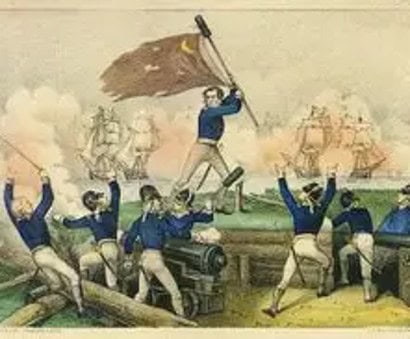
For nearly ten hours, the battle raged. Smoke filled the harbor as cannon fire echoed across the water. Despite being heavily outgunned, the defenders held their position. One of the most memorable moments occurred when the fort’s flagstaff was shot away. Amid enemy fire, Sergeant William Jasper leaped over the fort’s wall, recovered the flag, and raised it again on a makeshift staff, inspiring the defenders to continue the fight.
 As darkness approached, the British withdrew. Their fleet had suffered significant damage and hundreds of casualties. The Americans had won a stunning victory.
The triumph at Sullivan’s Island came just days before the adoption of the Declaration of Independence on July 4, 1776. The victory boosted Patriot morale and demonstrated that American forces could successfully resist the might of the British Empire. In honor of Colonel Moultrie’s defense, the fort was later named Fort Moultrie.
The battle also gave South Carolina one of its most enduring symbols. The palmetto tree, whose wood helped save the fort, became a symbol of the state’s courage and resilience. Today it appears prominently on the South Carolina state flag.
The Battle of Sullivan’s Island was more than a military victory. It protected Charleston for several years, inspired Patriots throughout the colonies, and provided a timely reminder that determination and ingenuity could overcome even the strongest enemy. As Americans moved toward independence, the defenders of Sullivan’s Island showed that freedom was a cause worth fighting for.
Our History Matters because the brave men who defended Sullivan’s Island in June 1776 helped prove that the American colonies could stand against the greatest military power in the world at that time, and secure the liberty we enjoy today. Remember the brave men and women who secured the freedoms we enjoy today.