
Peter Salem – A Colonial Hero
 Corbis/Getty Images
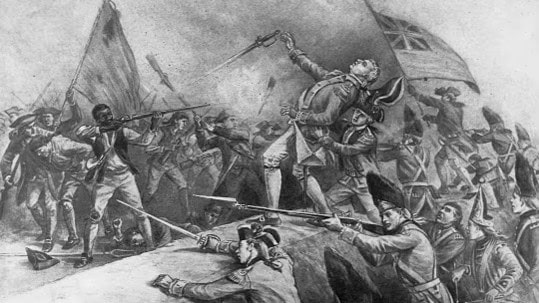
Peter Salem shooting British Royal Marine officer Major Pitcairn at Bunker Hill.
British soldiers advanced toward the American defenses at Breed’s Hill on June 17, 1775. The fighting was fierce, and the colonial defenders were running low on ammunition. Among the men standing their ground was a young African American patriot named Peter Salem. Born into slavery, he had never known the full meaning of freedom. Yet on this day, he was fighting for the freedom of a nation that had not yet been born.
Peter Salem was born in 1750 in Framingham, Massachusetts. His early life was spent in slavery. He was originally owned by Captain Jeremiah Belknap, who later sold him to Major Lawson Buckminster. As the conflict between Great Britain and the American colonies grew, Buckminster agreed to free Salem so that he could join the colonial militia.
On April 19, 1775, Salem joined Captain Simon Edgell’s company of Framingham Minutemen. He marched with other patriots toward Lexington and Concord, where the first battles of the American Revolution erupted. The colonies were now at war, and Salem had become part of the fight for independence.
On June 17, 1775, British forces attacked American positions on Breed’s Hill near Boston. Salem was serving in Colonel John Nixon’s Massachusetts Regiment, alongside other African American patriots.
The British launched repeated attacks against the American defenses. During the fighting, British Major John Pitcairn, who had been involved in the opening fighting at Lexington, was killed. American accounts credited Peter Salem with firing the shot that mortally wounded Pitcairn. Although historians have found conflicting accounts about exactly who fired the fatal shot, Salem’s name became closely associated with the event.
The Americans eventually withdrew from the hill, leaving the British in control of the battlefield. However, the British suffered heavy casualties, and the battle demonstrated that the colonial soldiers could stand against the experienced British Army.
Salem’s reputation as a hero continued to grow. In 1786, American artist John Trumbull painted The Death of General Warren at the Battle of Bunker Hill. The painting includes a Black soldier who has often been identified as Peter Salem, although that identification has never been conclusively established.
He continued serving in the Continental Army, reenlisting for additional terms. His military service took him to New York, where he participated in the campaign that included the Battle of White Plains. He also fought at Saratoga, Monmouth, and Stony Point. He remained in military service until March 1780, when he received his discharge.
Peter Salem was a man who had been born into slavery and had spent years serving in the struggle to establish American independence. He had marched, fought, and endured the hardships of a Revolutionary soldier. His contribution was part of a much larger story. Thousands of African American men served the American cause during the Revolutionary War.
After leaving the army, Salem returned to Massachusetts. He married Katy Benson in 1783 and eventually settled in Leicester. He earned his living through hard work, making baskets, repairing chairs, weaving, and gardening.
Unfortunately, the recognition he had received for his military service did not provide him with financial security. Peter Salem died on August 16, 1816, at the age of 66, in the Framingham poorhouse. He was buried in the Old Burying Ground in Framingham.
His grave did not have a marker for many years. In 1882, the town erected a granite monument in his memory. The inscription reads:
PETER SALEM
A SOLDIER OF THE REVOLUTION
CONCORD
BUNKER HILL
SARATOGA
DIED AUG. 16, 1816
He is remembered as one of the many African American patriots whose courage and sacrifice helped establish the United States of America. His story reminds us that the American Revolution was fought by people from many different backgrounds. Some were wealthy, some were poor, some were free, and others had only recently gained their freedom. Yet they stood together in the struggle for independence.
Peter Salem’s name deserves to be remembered among the heroes of our nation’s founding. Our History Matters because the story of America belongs to all those who helped make it possible.