
The British Attack Long Island

In the summer of 1776, America had declared its independence, but independence was far from secure. The British were determined to crush the rebellion, and they sent one of the largest military forces ever assembled in North America to New York. The British sent two brothers, General William Howe leading the Army and Lord Richard Howe leading the Navy, to end the rebellion.
The result was the Battle of Long Island, fought on August 27, 1776. It would become the largest battle of the American Revolutionary War by the number of soldiers engaged, with over 34,000 total, and one of the most important early battles of the conflict.
General George Washington had moved his Continental Army into New York to defend the city against the approaching British army. Washington understood the importance of New York. If the British captured the city, they would gain control of one of the largest major ports in America. It was also an important strategic position, if the British controlled the Hudson River, flowing from the North to New York City, they would split the colonies in two.
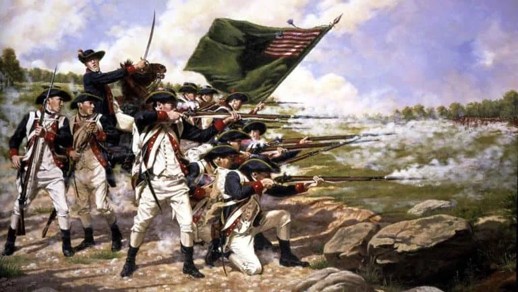 The British land force was commanded by General William Howe and included British soldiers and German Mercenary troops, being used for the first time in America. A powerful Royal Navy fleet supported them under the command of Lord Richard Howe. Washington’s army was greatly outnumbered and faced an enemy with more experienced soldiers and superior resources.
On August 22, British troops began landing on Long Island at Gravesend Bay. Five days later, General Howe launched his major attack against the American defenses. The Americans had fortified Brooklyn Heights across the East River from Manhattan. They also fortified the wooded Guan Heights to prevent the British from getting to Brooklyn. Washington hoped to inflict heavy causalities on the British troops as they attacked the heights, similar to Bunker Hill, before falling back to Brooklyn. There were four passes through the high ground they had fortified, and three of them were protected by the American soldiers. For an unknown reason, the pass on the far left of the American lines, called the Jamaican Pass, was not guarded. Only a handful of scouts were left there to watch for the enemy.
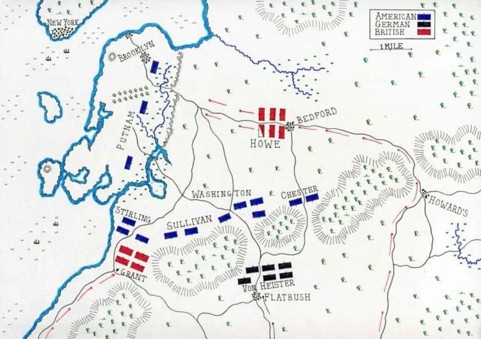 During the night, British troops moved around the American left flank through the undefended Jamaica Pass. When the British troops were in position, they fired two shots from their cannons as a signal for the rest of the army to attack the front of the American lines while they attacked the rear. The American soldiers found themselves in a dangerous position, with British forces attacking from the front and rear at the same time.
The fighting was intense. A brigade of American troops led by Lord Stirling held a hill that became known as “Battle Hill”. The British suffered the most of their casualties in this area. The “Maryland 400”, a unit from the state of Maryland, also earned a reputation in the battle for attacking repeatedly and helping to stall the British advance. The British numbers and strategy eventually overwhelmed the Continental Army. About two thousand American soldiers were killed, wounded, or captured as they fled into the defenses at Brooklyn. The British had lost about 400 casualties.
The defeat left Washington in a desperate situation. His army was pushed back into the defenses of Brooklyn Heights. They were encircled by the victorious British Army. The British Navy could enter the East River and use their cannons to destroy the American army.
As night fell, Washington and his officers faced a difficult decision. They could remain in Brooklyn and risk having the army captured and destroyed, or attempt to escape across the East River to Manhattan. Tune in next week to find out what happens.
Thank you for reading “Our History Matters. I always enjoy hearing from readers; contact me at: tj.cox2023@outlook.com with your questions, comments, ideas, or suggestions.
I have compiled all of my “Our History Matters” articles published from March 6 through July 31 into a magazine-style booklet. The booklet is 64 pages in an 8½ × 11-inch format and contains every article in one convenient volume. Copies are available for $10.00, so contact me to purchase one.
August 20, 2026 @ 11:01 am
I would like to get a copy.