
The Cherokee War of 1776: Southwest Virginia’s Revolutionary Frontier
 When Americans think about the Revolutionary War, they often picture the great battles fought between George Washington’s army and the British. But in 1776, another war was being fought much closer to home.
For the people living along the Holston and New River valleys, the American Revolution was also a struggle for survival on a dangerous frontier. Southwest Virginia had become a place where American settlers and the Cherokee Nation were competing for land and control of the region.
For generations, the Cherokee had occupied a vast homeland extending across portions of what are now Tennessee, North Carolina, South Carolina, Georgia, and southwestern Virginia. As settlers moved farther west, tensions increased. The British Proclamation of 1763 had attempted to restrict colonial settlement west of the Appalachian Mountains, but settlers continued moving into lands claimed by Native nations. With royal authority collapsing in 1775 and 1776, those restrictions became increasingly difficult to enforce.
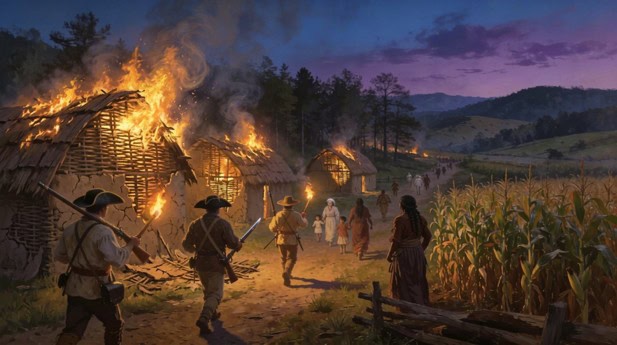 When the American Revolution began, many Cherokee leaders chose to support the British. British officials had long maintained relationships with the Cherokee, and some Cherokee leaders believed an alliance with Britain offered their best chance of stopping further settlement on their lands.
In the summer of 1776, Cherokee warriors attacked settlements along the southern and western frontier. These attacks reached the communities in and around the Holston and New River valleys, creating fear among settlers who lived far from the protection of Virginia’s larger population centers. Virginia responded by calling upon its frontier militia.
One of the most important leaders in this campaign was Colonel William Christian, a prominent Virginia officer from the New River Valley and brother-in-law of Patrick Henry. Christian had already served in Virginia’s military forces during the early years of the Revolution. In 1776, he left his Continental Army commission to take command of an expedition against the Cherokee.
Christian assembled a force of roughly 2,000 men, including Virginians and frontier settlers. The army moved south and west from the Holston Valley toward the Cherokee towns.
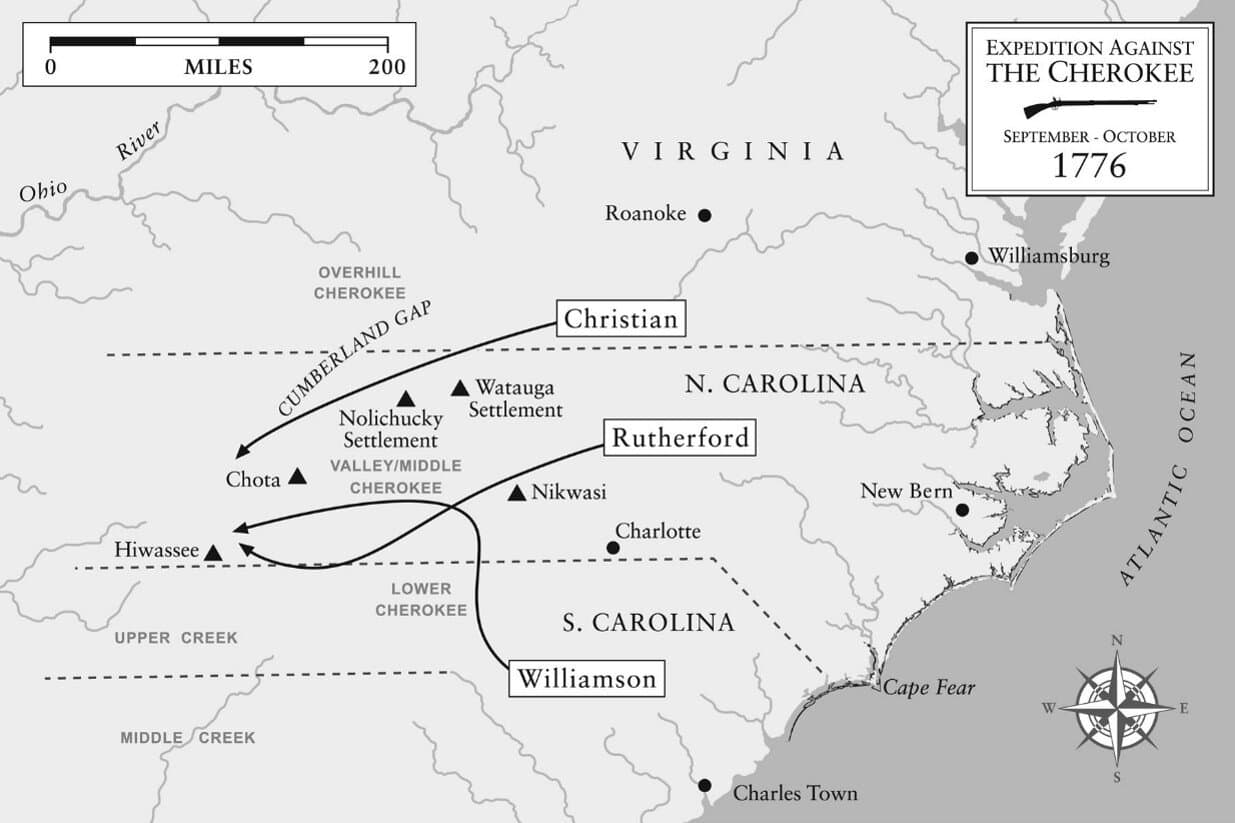 Christian’s campaign was not a conventional battlefield campaign. Instead of seeking one great battle, his forces moved through Cherokee territory, destroying towns, crops, and supplies.
In October and November 1776, Christian’s army reached the Overhill Cherokee country along the Little Tennessee and Tellico Rivers. Several Cherokee towns were destroyed. The campaign severely damaged Cherokee communities and their ability to continue the war.
The fighting demonstrated the brutal reality of frontier warfare. Settlers had lost homes and lives in Cherokee attacks, while Cherokee communities saw their towns, crops, and homes destroyed by American forces.
The Cherokee had hoped that their alliance with the British would help stop the settlers’ expansion. Instead, the British could not provide enough military support to protect Cherokee territory from American armies. By the winter of 1776–1777, many Cherokee leaders were ready to seek peace.
Peace negotiations led to the Treaty of Long Island of the Holston, signed on July 20, 1777. The treaty established a new boundary and required the Cherokee to surrender large areas of land. The agreement also provided access to the Cumberland Gap.
For Virginia’s settlers, the treaty provided a temporary period of peace and opened the way for continued settlement westward. Some Cherokee leaders refused to accept the surrender of their lands. Their resistance would lead to years of additional frontier warfare.
The war helped secure the frontier settlements along the Holston and New River Valleys. The treaty opened additional territory to American settlement and helped the continued movement of settlers toward Kentucky and beyond. But this expansion came at a tremendous cost to the Cherokee people.
Our History Matters because the story of the Cherokee War reminds us that our local history is connected to the larger story of the American Revolution—and that understanding that history requires us to remember all the people who lived through it.
Thank you for reading “Our History Matters. I always enjoy hearing from readers; contact me at tj.cox2023@outlook.com with your questions, comments, ideas, or suggestions.
I have compiled all of my “Our History Matters” articles published from March 6 through July 31 into a magazine-style booklet. The booklet is 64 pages in an 8½ × 11-inch format and contains every article in one convenient volume. Copies are available for $10.00, so contact me to purchase one.
September 3, 2026 @ 7:24 am
I discovered more history in this piece. I had never heard or had forgotten about this part of our history. Thank you for sharing!