
There’s no right or wrong way to say ‘Appalachia’
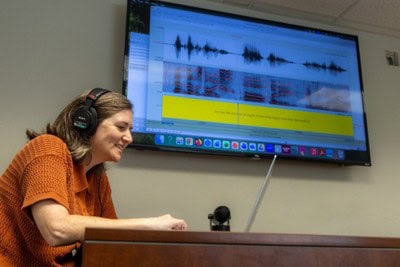 Abby Walker, associate professor of English and co-director of the Speech Lab, works on an audio project in the lab space in Shanks Hall. (Photo by Jasmine Rorrer for Virginia Tech.)
From Virginia Tech
People pronounce the word “Appalachia” differently and much of that contrast depends on where they live. But no matter how you say it, a Virginia Tech project shows that no one way trumps all. The differences are centered in historical and community influences.
The Speech Lab, housed in the English Department, partnered with the “Appodlachia” podcast to explore the differences in dialect across the 13-state Appalachian mountain region.
The work began with Abby Walker, co-director of the lab, who was interested in researching Appalachian accents and heard about the growing popularity of the podcast. The lab researches sociophonetics, language variation, and speech perception.
“As linguists, we don’t really care about right or wrong, we care about how people talk about things and the kind of attitude they have about the language they are speaking,” said Walker, associate professor of linguistics.
Chuck Corra, co-founder of Tennessee-based “Appodlachia,” asked individuals from across the region to send voice recordings of how they say the word “Appalachia.” He received more than 1,500 submissions. The mission of the podcast was to compare pronunciations across the region and to find the most common one, either “App-uh-LATCH-uh” or “App-uh-LAY-SHuh.”
He then created a series of YouTube videos comparing dialects in over 423 counties across 13 states, spreading from western New York all the way to northern Mississippi.
The research findings showed a trend of more “App-uh-LAY-SHuh” speakers in the northern and southern areas, while “App-uh-LATCH-uh” accents were concentrated in the middle of the region.
According to Corra, the goal of the project is to celebrate the diversity of dialects and the community history rooted in them.
“There’s been unfair discrimination against people who come from different areas of Appalachia,” he said. “I hope that people can look at this as an example of celebrating accents, and that we should be doing that instead of viewing dialects as lesser than.”
Walker and Charlie Farrington, co-leader of the project, worked with undergraduate student researchers across different majors and academic disciplines who all are part of the Southwest Virginia Language Project. They analyzed the audio recordings and put them into a digital visual concept. Their work resulted in the interactive website This is How You Correctly Say “Appalachia.”
“One of the things that makes language so cool is that it is so accessible, and everyone has all of these intuitions about it that it becomes a habit,” Walker said. “What we want to do is take the extra step and truly look into why certain patterns of language happen.”
Ethan Peterson, one of the student researchers, used his skills from his geographic information system and language sciences minors to organize recordings and build a visual map.
“The real rigor has come from the data and analyses on it, but the maps have been the nice, pretty product of all the hard work put into the behind-the-scenes of it all,” Peterson said.
The differences in dialect were associated with historical trends dating back to how the word was pronounced and taught across each community.
Since then, the lab team has presented its findings at several conferences, including the Southeast Conference on Linguistics in Georgia.
“Both linguists and non-linguists seem to have really taken to the work we did, and it’s really rewarding to see,” Peterson said.
The research team members have received a lot of feedback since publishing the website, with natives across Appalachia reaching out to thank them for representing their communities.
“Regardless of what you say, you’re correct in your hometown, as long as you feel positively about being from the area – that’s what really mattered to us in research,” said Farrington. “Humans vary in how we say things. It’s systematic in structure and there’s reasons behind it.”
Written by Anastasia Simonenko, intern with the College of Liberal Arts and Human Sciences marketing and communications team