
Where did the American Prisoners Go?
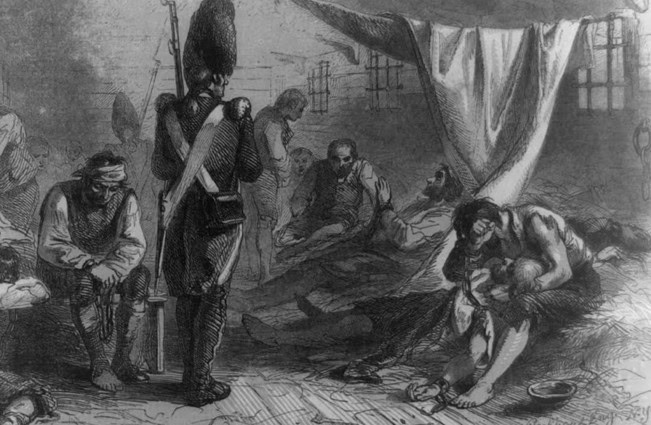 Interior of the Jersey prison ship during the Revolutionary War. Library of Congress
 Imagine surviving a battle for American independence; you are covered in dirt and sweat, with blood on your uniform from fellow soldiers who were beside you. Only to discover that your greatest struggle is just beginning. You have surrendered your weapon, been taken away from your unit, and placed aboard an old British ship anchored in New York Harbor. There is little food, almost no clean water, and hundreds of other prisoners are crowded around you. You have no idea how long you will remain there or whether you will ever see your family again.
When the American Revolution began, neither the Continental Congress nor the British government fully understood the enormous problem that would develop from capturing so many soldiers. Both sides took prisoners, but the British faced a particular problem. They did not recognize the Americans as soldiers fighting for an independent nation. Instead, many British officials considered them rebels committing treason against the Crown.
Following the American defeats at the Battles for New York in 1776, thousands of American soldiers were captured. The situation became even worse on November 16, 1776, when British forces attacked Fort Washington on Manhattan Island. Almost 3,000 American soldiers surrendered and became prisoners of war.
The British were not prepared to care for such large numbers of prisoners. Many were confined in abandoned buildings, warehouses, churches, and jails throughout New York City. Some were placed aboard old ships anchored in the harbor.
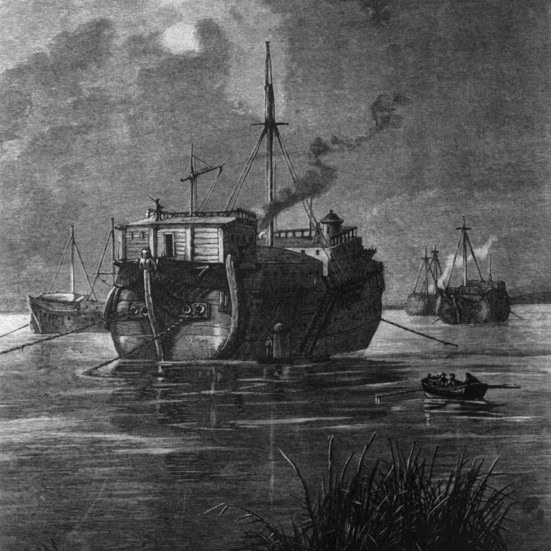
Among the most notorious prisons was the old British warship HMS Jersey, anchored in the bay near Brooklyn. The ship had once served in the Royal Navy, but it had been converted into a floating prison. American prisoners were crowded below decks with little ventilation, inadequate food and water, and poor sanitation. The ship became known as a floating nightmare.
Disease spread quickly. Smallpox, dysentery, and other illnesses took a terrible toll. Men who had survived the battlefield often died from sickness, disease, hunger, and neglect while imprisoned.
One of the men who experienced these conditions was Captain Thomas Dring, whose later recollections provided an important account of life aboard the prison ship. Another survivor, John Blatchford, described the prisoners as little more than skeletons, with many barely having enough clothing to cover themselves.
The suffering was not limited to Jersey. Thousands of Americans were held in other prison ships and land prisons. The Sugar House and the Provost Prison in New York became infamous places of confinement.
The exact number of Americans who died in British captivity is hard to determine. Historians estimate that approximately 12,000 or more Americans died in British prisons during the war.
The Continental Congress eventually recognized that something had to be done. In January 1777, Congress established the position of Commissary General of Prisoners. Elias Boudinot was appointed to oversee efforts to provide supplies and assistance to American prisoners.
Boudinot worked to obtain information about prisoners, improve their treatment, and arrange exchanges with the British. Prisoner exchanges were an important part of the war, but negotiations were often difficult. Officers sometimes received better treatment and could be released on parole after promising not to return to military service until formally exchanged. Ordinary soldiers generally had far fewer privileges.
When the Revolutionary War finally ended, surviving American prisoners were able to return home. Some had spent years in captivity. Others never returned to their families.
There is a monument in Brooklyn, New York, known as the Prison Ship Martyrs Monument. It stands in Fort Greene Park and honors the thousands of American patriots who died aboard British prison ships during the Revolution. Their remains were eventually gathered and reburied in a common tomb.
As we continue to celebrate America’s 250th birthday, let us remember that independence came at a tremendous cost. Some gave their lives on the battlefield. Others endured years of imprisonment, hunger, disease, sickness, and separation from their loved ones. Their history matters too.
Thank you for reading “Our History Matters. I always enjoy hearing from readers; contact me at tj.cox2023@outlook.com with your questions, comments, ideas, or suggestions.