Radford Council to consider R.E. tax hike, other increases
 By DAVID QUESENBERRY
Patriot Publishing
Radford City Council will advertise a 13-cent increase in the city’s real estate tax rate for the upcoming fiscal year.
During its Monday night budget session, Council authorized staff to proceed with advertisements for public hearings on several tax and utility rate increases under consideration for the upcoming fiscal year.
For advertising purposes the following tax rates were proposed:
Real Estate Tax – 82 cents per $100 of assessed value, up from 69 cents;
Personal Property Tax – $2.55 per $100 of assessed value, up from $2.44;
Cigarette Tax – 41cents per pack, up from 40 cents;
Prepared Meals Tax – 6.5 percent, up from 5.5 percent;
Hotel Occupancy Tax – 8.5 percent, up from 8 percent.
 The tax rates for advertisement were proposed during discussions by City Council. The rates were generally determined by: the advertising requirements for each tax; the ability to adjust the tax during the year; rates in other communities; and an agreed upper limit for the real estate tax rate. By proposing a real estate tax rate in excess of the current levy, Council would have some leeway in deciding among a range of real estate tax rates from no increase to the advertised value of 82 cents. Council is allowed to amend the real estate tax only once per year. The other proposed tax rates were determined by looking at rates in neighboring communities and seeking some way to spread the impact of the increases. Since advertising requirements were less, Council could amend these rates at any time during the year as may be needed.
The proposed changes in tax rates are in addition to proposed increases in utility rates for solid waste and water/wastewater service. Solid waste fees are proposed to increase three dollars a month, while water/wastewater charges would increase by eight dollars a month for customers using 4,000 gallons. None of the proposed taxes and utility rate changes have been approved since there must be a duly advertised public hearing before such changes may take effect. Council will conduct a first reading and public hearing on the overall budget and the proposed tax/utility rates at its April 14th meeting.
Before beginning his presentation on the General Fund Budget, Interim City Manager Craig Meadows told Council, “We’re here to work together to provide the highest level of service to the citizens of Radford that we’re able to do at a cost that is reasonable and fair. Radford is a wonderful city and has always provided an exemplary level of service. Unfortunately, it’s simply no longer possible to provide the level of service that our citizens have become accustomed to without some significant adjustments to the city budget, specifically the General Fund.”
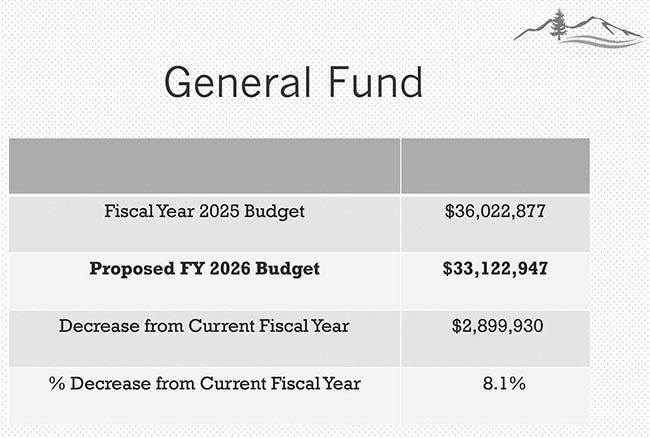
Meadows proposed a budget for the General Fund of $33.12 million, an 8.1 percent decrease from the current budget of $36 million. The budget was built on several assumptions as follows:
- Increase in real estate tax rate from 69 cents to 79 cents per hundred. (Council eventually agreed to advertise a rate of 82 cents).
- Reductions in funding to outside agencies and City schools (exact amounts still being determined).
- Elimination of all capital purchases in the General Fund except where required.
- Further reductions to be reviewed and discussed by the City’s department directors, constitutional officers, and City agency heads this week (Wednesday, April 2).
- 90 day freeze on filling vacant City positions.
The City’s proposed budget across all funds for Fiscal Year 2026 is $77,362,257 as compared to the current budget of $79,043,310 which is a reduction of 2.1 percent or $1.6 million.
Vice-Mayor Seth Gillespie asked that given the cuts and corrections mentioned so far, was that to get the City to a more reliable budget without addressing the amount the City was behind. Meadows responded that the proposed budget did not generate excess revenues to be able to catch up. It generated a balance to the proposed expenses for the next year only.
Mayor David Horton asked since revenue projections were off in the past, how has that been corrected for this year. Meadows responded that at the next meeting he hoped to have a slide that will have comparisons for the major categories of revenue. Horton asked Meadows if he felt more confident about the numbers he submitted for revenues. Meadows responded that he did.
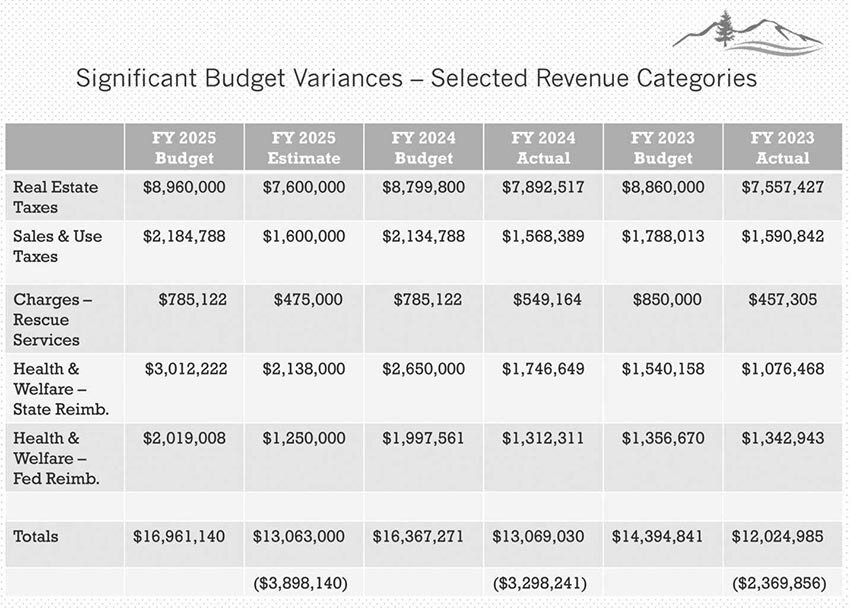
Horton’s question was prompted by an earlier review of select General Fund revenues by Meadows. The review highlighted the City’s problem of not generating reserves, which Meadows felt was due to the estimation of major revenue line items. Those line items were real estate taxes; sales and use taxes; rescue service charges; and state and federal reimbursements for health and welfare.
In his presentation based on accounting records and City audits, Meadows said the challenge was that the actual collection rates were below budget revenue estimates. It appeared that these five revenue sources would be $3.9 million below the budgeted estimate for the current year. For the previous two years, the shortfall was $3.29 million and $2.36 million between actual collections and the budgeted amount. What these numbers meant he said, were that expenses in the General Fund had to be less than these amounts for the fund to gain revenues or reserves, which they were not.
Councilwoman Jessi Foster asked if the discrepancy was caused by outstanding taxes, delinquency issues, or that the calculations on expected revenues were elevated. Meadows responded that he had gone back through the calculations and in his opinion felt it was an error in estimation.
Concerning the upcoming budget, Meadows said he and the Finance Director spent a lot of time looking at revenues to make sure that what was estimated for the coming year was achievable. If a community he said, had large reserves and missed their revenue estimates they could afford to have their reserves carry that. However, Meadows said, “We’re not there anymore and we can’t afford those kind of misses.”
Commenting on the situation of the City’s finances, Councilman Gillespie said, “I think this gets us to a presentable budget moving forward, but it doesn’t address the elephant in the room of where we are. If you take into account that we average three AEP payments behind at $1.5 million each, that’s $4.5 million; three school payments of I think it’s $485,000 which would bring us about $1.45 million; a $4 million RAN (Revenue Anticipation Note) and then in the bank it seems like we average $1.5 million to $2.5 million in cash fairly regularly. I mean that puts us anywhere between $6 million and $9 million upside down to catch up. I think we have to do more. We’re going to have to go back and look at more cuts. We just have to. I mean Radford is going to just have to stomach it if we want to do what it’s going to take to remain a city.”
The next scheduled meeting of the Radford City Council will be a budget work session at 6:00 p.m. on Monday, April 7, 2025 in the Council chambers of the Radford City Hall at 10 Robertson Street. Council is currently scheduled to conduct a first reading of the FY 2026 budget and proposed tax and utility rates on Monday, April 14, 2025.