
The Battle of the Cedars
 Why didn’t Canada become the 14th Colony? Why didn’t the people of Canada join the thirteen colonies in rebellion against the British Crown? The answer is complex, with several important reasons behind it.
In 1776, Canada was not a single unified nation. Different regions had different loyalties and interests. Nova Scotia, for example, was largely populated by loyal English settlers and served as a major base for the British Navy. It remained firmly loyal to Britain throughout the Revolution.
The region around Quebec was very different. Until the end of the French and Indian War—part of the larger conflict known as the Seven Years’ War—Quebec had been a French province. Most of its people spoke French and practiced the Catholic faith. In 1774, the British Parliament passed the Quebec Act, guaranteeing French Canadians the right to keep their language, religion, and French civil law. Many Canadians saw little reason to risk rebellion when Britain had already protected their traditions and way of life.
 At the same time, many American colonists strongly opposed the Quebec Act. Patriot leaders denounced it, causing concern among French Canadians who feared that joining the rebellion might threaten their religious and cultural freedoms.
Native American tribes in Canada and the western frontier also played a major role. For years, the British had maintained trading relationships and military alliances with many tribes. Native leaders feared that American settlers would continue pushing westward onto tribal lands if the colonies gained independence. As a result, many Native groups supported the British cause.
Canada also lacked the population needed to sustain a widespread rebellion. Settlements were sparse and scattered across vast distances, making organization difficult. Many residents were satisfied with the existing government and preferred stability over revolution.
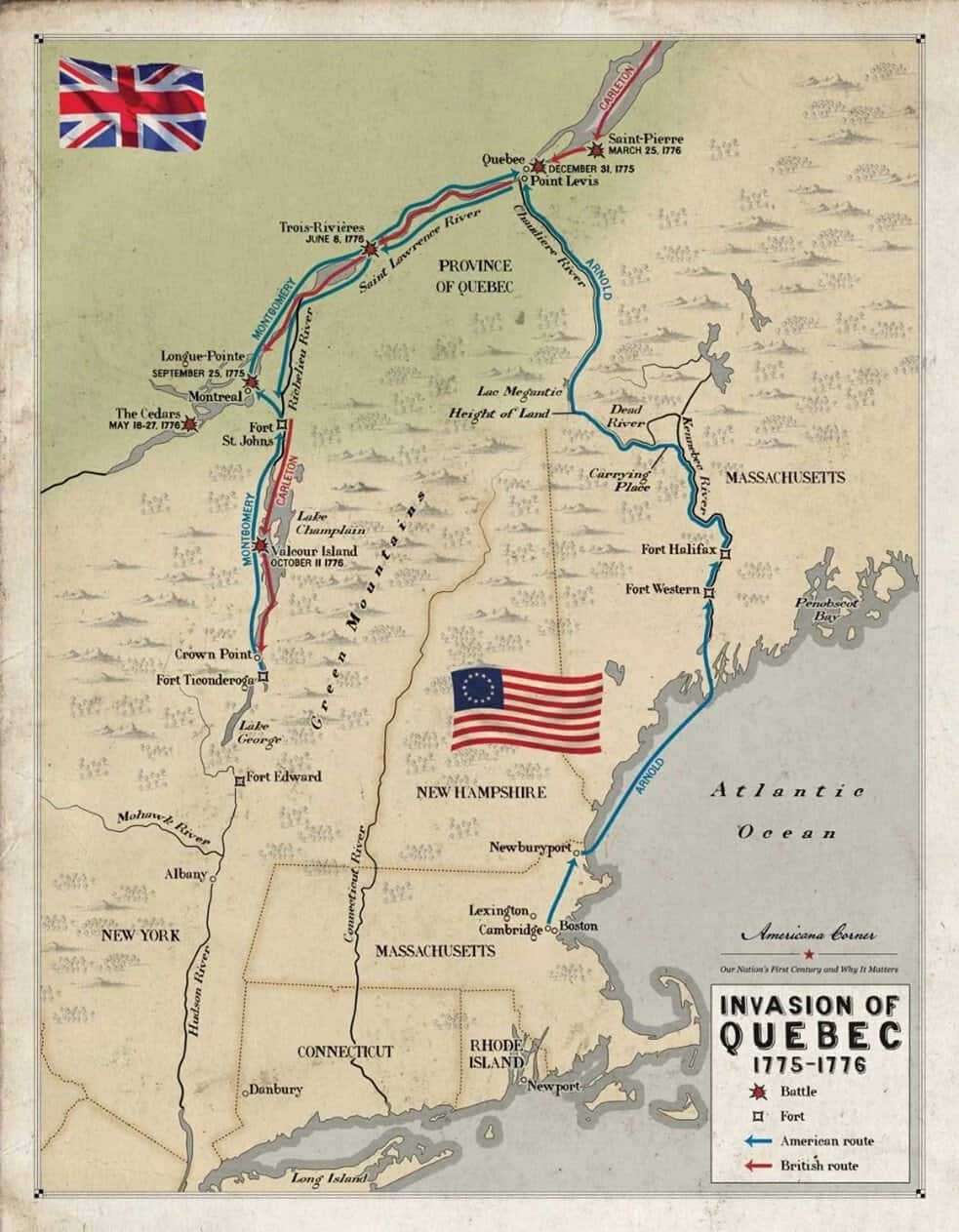
Despite these challenges, the Americans attempted to capture Canada in 1775. Two American armies marched north. One force, led by General Richard Montgomery, captured Montreal before joining General Benedict Arnold in an assault on Quebec City. During a fierce snowstorm on December 31, 1775, the Americans attacked the city but were badly defeated. Montgomery was killed, Arnold was wounded, and the surviving Americans were eventually forced to retreat. The campaign to seize Quebec had failed.
Following the disaster at Quebec, American leaders tried to hold the territory they had already gained. Along the St. Lawrence River west of Montreal, American forces constructed a small wooden fort at a settlement known as the Cedars. The outpost was intended to block British movement along the river and protect Montreal from attack. The fort was commanded by Colonel Timothy Bedel and defended largely by inexperienced militia soldiers.
In mid-May 1776, British Captain George Forster advanced against the fort with a mixed force of British regulars, Loyalists, and Native allies, including many Mohawk warriors. Although the Americans technically outnumbered the attackers, fear spread quickly through the fort as reports circulated of approaching Native war parties.
On May 19, Captain Forster demanded the surrender of the post. Major Isaac Butterfield surrendered the fort on May 20, handing over more than 350 American soldiers as prisoners of war. An American relief force sent to rescue the garrison was also captured before it could arrive.
The defeat at the Cedars became one of the darkest moments of the Revolution’s northern campaign. American control around Montreal weakened dramatically, and many feared the entire effort to secure Canada was collapsing. Continental forces soon began retreating southward toward New York, ending serious hopes that Canada might join the Patriot cause.
Though far smaller than the famous battles around Boston, the fighting at the Cedars demonstrated just how uncertain the Patriot cause remained during the second year of the Revolution. The war for independence was being fought not only in major cities, but also along isolated rivers, deep forests, and distant settlements where even a single defeat could carry enormous consequences.
Meanwhile, General George Washington feared the British would soon strike New York. Control of the sea—and the powerful British Navy—would likely determine the fate of the city and perhaps the future of the Revolution itself.Top of FormBottom of Form
May 28, 2026 @ 7:58 am
I love history and appreciate you throwing this in there.
The information shared represents little known aspects of the fight for Independence and I definitely learned some things, making you ponder how different the map might look today if Montgomery and Arnold had been successful.
Since we can’t since we can’t seem to get detailed articles of important local interest such as why the I 81 bridge project over the New River has been such a travesty and has drug out for so long, I hope we see more of this kind of thing in The Patriot.
May 28, 2026 @ 8:44 am
This article was very interesting and informative. It is well written and contains a lot of things I was not aware of. Keep them coming!!!